 “Many people travel, but you are a journeyman.”
Thank you to my friend Morene for sending this my way…I hope to live up to it. This is indeed a journey on so many levels. It is the perfect quote to begin this week’s post.
It’s kind of a long post this week….but if you look at nothing else, don’t miss the two video clips below.
A little about where I am. Mozambique is one of the five poorest countries in the world with an average income of about $1 a day. About 12% of the 15-49 age group has HIV/AIDS. It has an adult literacy rate of only about 46%, but that is hugely improved from 30 years ago. Although a high percentage of children are enrolled in schools, they don’t all actually go. Further, many of those that do go don’t actually learn much because of the caliber of the teaching. Internet access is about 4%.
Mozambique is one of about 54 countries in Africa, and is about twice the size of California, or a little smaller than the province of Ontario. It is on the southeast part of the continent, hugging the east coast, just north of South Africa and Swaziland. It is also bordered by Zimbabwe and Zambia to the west, Malawi and Tanzania to the north, and the Indian ocean to the east. Marriages are often polygamous in rural communities, with men having 2, 3, or more “wives” here. It is not uncommon for 10 kids in single family, and I have heard of some men with upwards of 30 kids from a number of partners! What up, bro! Many fathers clearly do not take their role very seriously here.
The Portuguese settled this country, and it remains the official language even though they pulled out in 1975, after the war for independence. Then the civil war began, lasting 17 years until 1992. Add in floods, cyclones, cholera, and malaria, and you can see how Mozambique has its challenges.
Malaria is a nasty and sometimes deadly disease that attacks the liver, caused by a parasite carried by the mosquito. They tend to come out mainly at night and can only fly about a kilometer or two. People who live here tend to build up some immunity. Although malaria is more of a rural than urban phenomena, it is now rainy season here, making it even more widespread. There is one huge, main central public hospital in Maputo. Which mean that people come from all areas to be treated for their ills, including malaria. Which means that those that are bitten here in town pass the parasite onto these mosquitos, they bite someone else, and so on. All of a sudden we have a potential central distribution point for malaria!
I regard every mosquito with utmost suspicion, which then turns into a fight to the death. I am taking my pills faithfully just to be safe.
There are about 20 different languages in Mozambique, some very specific to different regions…and we think in Canada that two official languages is complicated to manage! Mozambique has a population of about 22 million, spread out over 10 provinces, almost 2 million of which are in the capital city of Maputo (in Maputo province), which is where I am. Maputo is in the very south end of the country, only about 80 km from the South African border. It’s hot certainly…about 30-34 C are typical highs this time of year. Quite humid and muggy, and not much of a breeze. But it’s bearable, and you sort of get used to it (I was expecting worse). Yet all the men wear long pants, and almost no one wears shorts! So do I for work, but I don’t like it.
The massive amounts of rain continues to be a problem just north of us in particular, with more than 36 dead, and almost 100,000 displaced since my last update. To make matters even worse, a crocodile farm flooded, releasing 15,000 crocs into the Limpopo river. They have recaptured only about 2,000.
For all of you who generously donated $800 in cash as well as soccer balls, pumps, and pens…I think that putting it all towards helping these flood victims might be the best use. Homes, schools, and entire villages have been wiped out. More on that when I figure out how to best do this.

Public transit in Maputo
Dirty, smelly, loud, bustling, hustling…Maputo is not much different from any other big city. Rich and poor. So many different people, classes, cultures, nationalities coexisting. People are generally well dressed (particularly on Sundays) and polite. There are hardly any street people here, compared to what I am used to seeing at home. I haven’t been asked for money yet. Hustled yes. Trying to sell me things…all the time. But no panhandling.There are absolutely no rights for pedestrians and I mean NONE (you have to be looking all ways all the time). Stop signs mean nothing. Drivers are very aggressive…it makes driving in Montreal seem like a field day. This is very different from how they are as people. Cars seem to have a way of bringing out the worst in people no matter where they are. So many cars here, and people park wherever they want, including the sidewalk (and no tickets!). There is garbage and broken glass everywhere. Certainly no recycling program in Maputo! Everyone has a cell phone which seems strange here, but I guess communicating remains a powerful human need wherever you are.
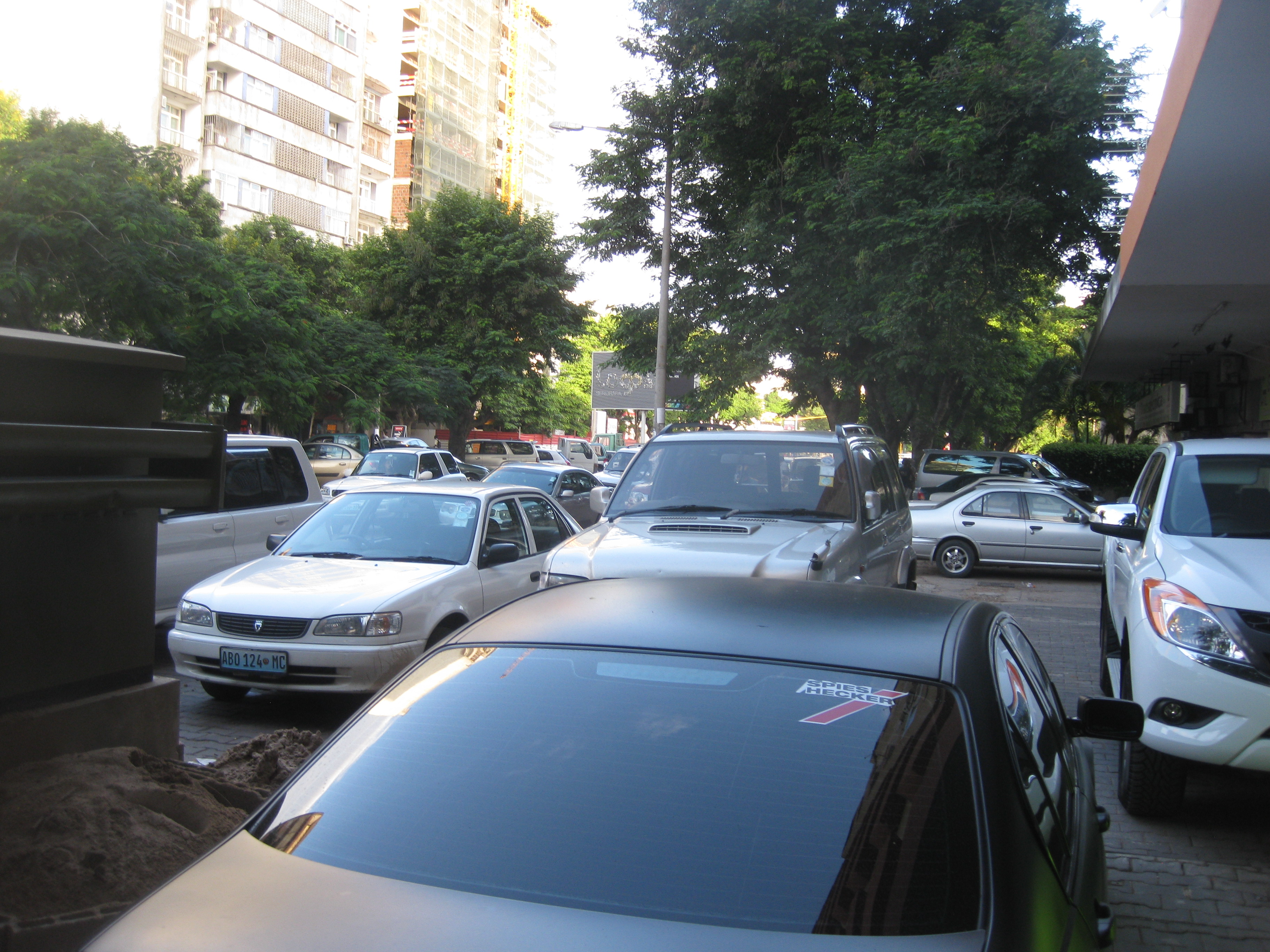
So many cars, so little space for pedestrians!
Everyone is trying to sell something wherever you turn. VERY enterprising people! The street and sidewalks are a mess…big gaping holes everywhere. I have yet to see a police officer, car, or station, although there are guards everywhere, along with gates, electric fence “deterrents,” and razor wire.It’s total chaos…but somehow…it just works. Not the way I’m used to, but it works.
This is purely anecdotal, but I sense that many of our western problems–for example guns, bullying, drugs and alcohol, obesity–are much less of an issue here. Which doesn’t mean they don’t have their own issues, but it is interesting to think about why, and how much people of different backgrounds could learn from each other. Wouldn’t it be great if we could cherry pick and combine the best traits of all cultures?
The cost of living is much like at home. No bargains to be had here on food, drink, clothes, accommodation, travel, etc…prices are usually at least as much as home, and often more. For example, $200-250 a night for a hotel room would be about average. Because Maputo is bustling city with money, people here charge what they think they can get, and strangely, stick to their guns, and can usually get it. They are willing to lose sale for the sake of keeping prices inflated. I stopped for some fresh flowers…they had tons of them, and it was the end of the day. They wanted about $10, which I felt was way too high. So rather than deal, they let me walk. I suspect this is a big city phenomena though, and that in the rural areas this would be a much different experience. I also wonder how long this over-inflated bubble can last. And I also wonder how people who live and work here manage.
It’s a very interesting and strange mix of things here. The street names in Maputo for example…Mao Tse Tung, Vladimir Lenin, Karl Marx….all over the map. Lots of foreign money here as well…the Chinese built the stadium and the presidential palace (using their very own convicts!). Maybe they’re just being friendly. Surely they don’t want anything in return!
Someone told me that one of the things they like about Mozambique is the diversity….and that anything that can happen, and usually does. There’s an up and down side to that I guess. It’s a fairly liberal place compared to some other stricter African countries, with a definite Latino feel and flair. On Friday night for example I found myself at the opening of an art exhibit….at the German cultural centre! I was surrounded by Germans, Mozambicans, and many other nationalities, speaking all kinds of languages. I generally don’t like these sorts of gatherings as most of you know–too fluffy and stuffy, I am generally just uncomfortable, and for some reason anxious–but I tried to keep on open mind anyway. I especially enjoyed a couple of local musicians, and thanked them for their performance.
“Music is the language of a 1000 nations.”
More inspiring words sent to me by my good friend Thomas. Thank you….
Saturday afternoon I was walking around town, when all of a sudden I heard these beautiful sounds. I followed the sounds to a municipal garden on the ocean. As I walked into the park I saw this huge tree, and underneath it, a large group of very well dressed people. It was a wedding, and they were all singing and dancing. Another one of those magic moments. I tried to be as inconspicuous as possible (not really successfully mind you) and managed to capture this bit of video.
Then I started thinking that it would be a great thing to somehow connect and play with local musicians. Try to do here what I love to do at home, and how incredible it would be to learn their style of music. So out into the universe that thought went.
Sunday night I went to see a local band perform at Cafe Camisa…a cool little local spot for music, and attached to Nucleo de Arte (art nucleus), a workshop/studio where dozens of local artists come to paint, sculpt, play. It was a wild show, with a thumping, almost hypnotic, rhythm.
The musician dude (Ivan) that I thanked on Friday at the German cultural centre (see above), was at this club and recognized me. I talked to him about wanting to play with some local musicians and he offered to introduce me to one of the band members who was just finishing a set. Chico Antonio is an older guy, very talented, and as it turns out is one of the best known and accomplished musicians in Mozambique. He is the main guy in the video clip. So I started chatting with him and he offered to jam with me, and introduce me to other musicians! I finally connected with him today, and hope it will lead to something. Regardless, it was pretty cool how all the pieces just sort of clicked together following my intention.
Being open to the flow
Faces look back at you as you look at them. Cautious mirrors cautious, open reflects open. Smiles bring smiles. Raising your hand as a greeting gets you the same in return. Pretty simple equation, but a valuable lesson and reminder in human nature.
I have connected with many of the staff at the apartment-hotel and know most of them by name. They appreciate the effort. I think they get a kick out of me for some reason. They have a special handshake here, and I have tried to learn it and practice it on them regularly. They love that…I can hear them all chuckling and laughing as I walk away, genuinely amused. Big white guy trying to do handshake, they must be thinking. Funny guy that Mr. Jonatan! Some of them are actually seeking me out…going out of their way to connect and say “ola,” so that’s kind of cool. It feels genuine.
At work I have connected with a few people, after ongoing effort and patience. Tomas (pronounced Tomash), an older educated guy, a telecommunications engineer who also teaches mathematics. He took me to lunch last Friday which I really appreciated. But my favourite is Helder…probably about my age. He is a driver, but also provides logistics and coordination support for the program. Really bright, thoughtful, deep guy who understands big picture issues. He picks me up and drops me off every day. And he has my back. In his limited English and my even more limited Portuguese, we somehow make ourselves understood. He wasn’t sure about me at first, I could tell, but after a day or two, he came around. I mean, how long did he really think he would be able to resist my charm?
I finally connected with one of the women at the office…Denise. We had never exchanged more than a few words. But Tuesday morning I complimented her on her hair, and all of a sudden discovered she could speak English! We talked about culture and music…turns out she’s a singer too, and she has also offered to introduce me to other local musicians!
Not knowing the language is a real barrier, but somehow I am learning to get by. It’s hard though. Now that the novelty of being here is starting to wear off, and the routine is setting in I am starting to find it more difficult in some ways. I get up, go to work, come “home,” usually go out for a walk and a quick bite, do some writing, watch some TV (two English channels: CNN international which is pretty good or bad movie channel), meditate, and go to bed. Then repeat. It is mind expanding and new, but also kind of a lonely, isolating experience in a way and I do miss my wife, son, family, and friends. I will have to find a different gear with six weeks to go. Highs and lows are to be expected….I know I must continue to embrace the opportunity I have here.
‘Til next week…
MoJo
 servingothersblog.com